Showing posts with label Marilu Tolo. Show all posts

Night of Violence


"We communicate with words. That's how we understand."

Carla Pratesi (Héléne Chanel), the oldest daughter of an esteemed ambassador, is working as a high-class call girl in Rome. On her way to pay off a blackmailer who threatens to make her secret public, her car has a blowout and she is chased into the woods and strangled by a mysterious stranger. Inspector Ferretti (Alberto Lupo) quickly takes up the case and discovers a vast ring of drug smugglers and human traffickers. But each night, more women are attacked - and multiple witnesses claim that the killer is Mario Vivaldi, a famous actor. Not content to sit around and watch the press malign her family's name, Carla's sister (Marilú Tolo) decides to pursue the killer herself. Who is the killer and what motivates him to attack women? Can Inspector Ferretti stop him? And will Carla's sister be the next victim?

Night of Violence (not to be confused with Night After Night After Night) comes from the earliest period of giallo, when the genre was still figuring itself out and establishing its tropes. It has a masked killer who strikes a series of beautiful women, but this one plays out more as a police procedural, tracking not only the killer's movements, but the methodical course of the police investigation. It's very straightforward storytelling and, much like Watch Me When I Kill, the killer's identity and motivation stem from the horrors of actual 20th Century history.

• The music in this film is fantastic. The mix of Italian big band and R&B music is very hip for 1965. Composer Aldo Piga also scored A... For Assassin.
• Writer/Director Roberto Mauri would go on to write Clap... You're Dead, which also features a murder investigation on the set of a movie-within-a-movie.
• The original Italian title is Le Notti Della Violenza, so the translation should more accurately be Nights of Violence (plural).

What the Hell Am I Watching?
 
You read correctly - Marilú Tolo's character doesn't get a name in the movie. She's only ever referred to as "Carla's sister."
 
 Also, Carla's sister is the only character smart enough to realize that the killer is wearing masks.

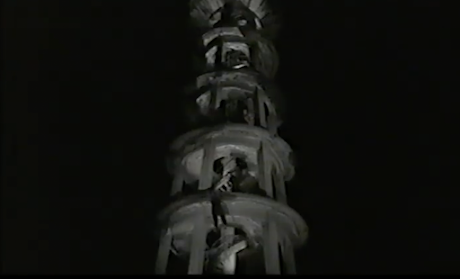
In the finale, the killer forces Carla's sister up a massive spiral staircase (an observation tower? Campanile?). When she slips and dangles off the edge, the police just stand there and look around at each other. No effort is made to help her, catch her or even run to break her fall. Rome's finest. 

Fashion Moment:

Carla starts the movie off with a bang (figuratively).

But her sister is the one who really shines in a chic black dress, lush leopard coat and accent jewelry.

Later at the stakeout, she adds a fashionable newsboy hat to the look.

And finally, here's a good look at the killer's mask. Kind of looks like Michael Meyers with a mustache.


Murder By Music


Murder By Music

"Killed her? I hardly knew her!"

Navy officer Richard Milford (Brett Halsey) has returned to London to visit his sister Catherine, but he is shocked to discover that she is dead, having jumped from the window of her flat – the same way her music professor killed himself the day before. Though the police label these as unrelated suicides, Catherine's classmate Helen (Marilú Tolo) believes it was murder and helps Richard to investigate. Before long their investigation puts them in the middle of a turf war between a Romanian street thug and a hippie cult leader. The clues lead to a drug den, a psychedelic nightclub called The Mousehole, a double-crossing gun moll, and a mysterious, unpublished 18th century musical composition called "The Trumpets of the Apocalypse."  Were these suspicious deaths really suicides? And if not, how were the murders committed?

Murder By Music goes by many names and you'll find it on YouTube under the title Perversion Story (though it should not be confused for Lucio Fulci's giallo Una Sull'altra, which also goes by the name Perversion Story and was released the same year).  The movie meanders quite a bit and more effort is put into getting Richard into and out of street fights than into progressing the mystery.  As a document of late-60's culture, though, it's interesting to see how the movie plays off audiences' fears of the hippie counterculture and the dangers of psychedelic drugs, and depicts flower-child characters as the broadest of caricatures.

  • Director Julio Buchs is most famous for his Westerns, including A Bullet For Sandoval (starring the great Ernest Borgnine), which was released the same year as Murder By Music.
  • The score by Gianni Ferrio is a strange mix of noir-style saxaphone-and-vibes jazz music and high-energy Hammond-organ-based psych rock. There's also a bit of Morricone-esque free-rhythm bop in there, but somehow it all works. Ferrio would go on to score such notable gialli as Puzzle, The Bloodstained Butterfly, and Death Walks at Midnight
  • Richard keeps saying that the creepy organ grinder is playing a hurdy-gurdy when, in fact, he is cranking a simple music box.
  • Note the two harps at Professor Stone's house. And we get a shot of the action framed through the strings, just like in Blood and Black Lace.
  • Not to give too much away, but the 3rd act reveal of how the deaths occurred reminds me of a similar device in Crimes of the Black Cat. And it also presages The Ring.
What the Hell am I Watching?

Early in the investigation, Richard starts a fight at The Mousehole and ends up taking on a whole club full of (supposedly non-violent) hippies.  It's about 200-to-one. At this point we discover that Richard is either very brave or very stupid.

About halfway through the film, the killer breaks into Helen's house, chloroforms her, and rifles through her things. She doesn't feel the need to mention this until days later.

Fashion Moment

It's swinging London, baby!  And it looks like the 60's threw up all over this movie.