Showing posts with label Mario Bava. Show all posts

Five Dolls For an August Moon


Five Dolls For an August Moon
"Only murderers kill."

Wealthy industrialist George Stark (Teodoro Corrá) has invited friends to his remote island estate for a reunion and the group includes Professor Fritz Farrell (William Berger), who has just developed an innovative new formula for an industrial resin. But while the other guests fall over themselves to invest, Fritz isn't taking any offers. When the party becomes stranded on the island and people start turning up dead, it's clear that someone is willing to kill for the money or the formula – or both.  Could it be the Professor's wife, Trudy (Ira Von Fürstenberg) who is having an affair with George's wife, Jill (Edith Meloni)? Or perhaps it's Nick Cheney (Maurice Poli) and his wife Marie (Edwige Fenech), who aren't averse to using their open relationship to get what they want. A killer is on the loose and no one is safe!

Five Dolls For an August Moon (not to be confused with Blue Eyes of the Broken Doll) is based on Agatha Christie's Ten Little Indians. It's a solid formula worthy of repetition but, alas, Mario Bava brings little innovation to his version. It's not particularly sexy or bloody and we seldom see the kills - just people discovering the bodies, which is sadly anticlimactic. None of the characters show any passion in their greed and, to be honest, the storyline with the secret formula is kind of dull. If you're interested in a much better version of the same story, I recommend Nine Guests For a Crime. What Five Dolls does have, though, is style to burn. The clothes and the sets and the swanky modern opulence of the movie are undeniable. I like to think of Five Dolls, with its large cast and complex criss-cross of motives as Bava's warmup for his next film, the much better Bay of Blood.
  • This movie was released in Italy on Valentine's Day 1970.
  • Rumor has it that the production was so rushed that Bava started shooting three days after agreeing to direct. The whole shoot took 19 days.
  • This was Edwige Fenech's first giallo.
What the Hell Am I Watching?

Perhaps the coolest thing in the movie is that the guests decide to store the dead bodies in the kitchen's meat freezer. So we're repeatedly treated to the sight of bloody bodies in plastic bags slowly filling up the crowded little room over the course of the film.

With all the similar-looking faces and a lack of contrasting characterization, it gets a little confusing telling people apart. Adding to the confusion: there's a character called Jack and a different character called Jaques.

Pentathol bullets? Is that a thing? Is that even possible?

Fashion Moment

This is the real reason to watch the movie. Crazy costumes abound, with psychedelic gowns, foppish ascots, gold lamé bell-bottoms, and unbuttoned satin disco shirts billowing in the breeze. One of my favorites is this strange white bikini, modeled by Edwige Fenech.


Also, the beautiful cliff-side house itself, with sleek modern architecture contrasts nicely with its rocky surroundings.


The Girl Who Knew Too Much


The Girl Who Knew Too Much

"Oh mother. Murders don't just happen like that here. "

Nora Davis (Leticia Roman) is a young American tourist and an avid reader of crime novels, who has an exciting first day in Rome. First, the kind man on the plane who offered her a cigarette is arrested at the airport for smuggling marijuana. Then, after her elderly host dies unexpectedly of a heart attack, she runs for help and is knocked unconscious on the Spanish Steps by a mugger. In her delirious state, Nora witnesses a woman getting stabbed to death nearby but when she awakes, no one believes her story, dismissing it as the result of too many mystery novels and a youthful imagination. When Laura (Valentina Cortese), a neighbor of Nora's late host, lets Nora stay at her apartment, things seem to return to normal – until the maid reveals that a murder really did take place, just as Nora described... ten years ago!  Did Nora experience a psychic vision of the crime? Or could it just be a delusion, brought on by the marijuana cigarette she accidentally smoked? And who is the stranger in the shabby sport coat who follows her around? With help from the handsome Doctor Marcello Bassi (John Saxon), Nora intends to untangle the mystery!

The Girl Who Knew Too Much is cited as the first giallo - the movie that started the craze for stylish Italian murder mysteries. It's also Mario Bava's last black and white movie.  Even if the title wasn't a giveaway, it's not hard to see that this film is Mario Bava's homage to Alfred Hitchcock. It borrows many of Hitchcock's favorite themes and stylistic cues, like the creative use of suspense, touches of humor to counter-balance the dark subject matter, and a director cameo. Even though the killer's motives don't really make sense and the plot is driven by an outrageous string of coincidences, this is still an enjoyable film that I recommend highly.
  • Being the first movie of its genre, The Girl Who Knew Too Much sets up quite a few precedents:  the curious amateur detective, a main character with a story that no one else believes, inept police, high body count, flirting with the paranormal, and a story that starts in the middle, expanding beyond the temporal boundaries of the film, just to name a few.
  • Bava mixes genres beautifully in this film, bringing elements of romantic comedy to his crime thriller. It's a shame that more giallo film makers didn't emulate this.
  • There are famous stories about how John Saxon and Mario Bava didn't get along during production of The Girl Who Knew Too Much. I met John Saxon once at a horror movie convention and, while he was charming and friendly and happily autographed my DVD, he evaded all my questions about the film.
  • One of my favorite moments is at the end, when we see rays of light beaming through two bullet holes in a door. It's a dramatic effect that's been copied in countless movies.
  • Dante DiPaolo, who plays the reporter, Landini, was married late in life to Rosemary Clooney. This makes him stepfather to Miguel Ferrer, stepfather-in-law to Debbie Boone, brother-in-law to Nick Clooney, and uncle to George Clooney.
What the Hell am I Watching?

The Girl Who Knew Too Much is really the story of a young murder mystery novel-loving woman who discovers that she's the main character in a murder mystery. It's meta and self-referential before that was even a thing. Basically, it's the Scream of the 1960's.

Fashion Moment

Nora is looking FIERCE in this python-skin trench coat.


Naked You Die

 
Naked You Die

"You have to tell me! Any moment the murderer could do it again."

St. Hilda College is a prestigious private academy for rich, beautiful young women, but this semester the students are getting an education... in murder! Someone is killing off the girls (and a few members of the staff) and plucky aspiring crime novelist Gille (Sally Smith) wants to be the first to get to the bottom of the case. Before long, Inspector Durand (Michael Rennie) is on the case, sorting out suspects and motives. Could it be dashing riding professor Richard Barrett (Mark Damon), who is having a secret affair with a student? Or perhaps stern Headmistress Transfield (Vivian Stapleton)? What is the killer's motive and why did he ship his first victim all the way to the school in a steamer trunk?

Naked You Die is a fantastic early giallo from Antonio Margheriti, with an uncredited script by Mario Bava. With that kind of pedigree, how could it not be one of the best gialli ever? Bava's fingerprints are all over this one, from the many references to Psycho (two bathroom murders, a top-of-the-stairs attack, and the twist ending) to the mystery novel-loving heroine Gille, who is clearly a variation on Leticia Roman's character in The Girl Who Knew Too Much.  Even though there's almost no blood and the only nudity is fleeting, the story holds up, the pace is quick, and the characters are well-defined. Further, it's a significant stepping stone in the development of the genre: thematically, a direct line can be drawn from Psycho, through Naked You Die to Torso, which led to the development of the slasher flick.

  • Two of the five victims are naked at the time of their death so, technically, the title holds up.
  • Sci-fi fans will undoubtedly recognize Michael Rennie, who plays Inspector Durand, from his most famous role as Klaatu in 1952's The Day The Earth Stood Still.
  • Mark Damon mostly retired from acting in the 1970's and turned his attention behind the cameras. He has become a producer of some major films including Wolfgang Petersen's Das Boot (1981), The Lost Boys (1987), and Monster (2002) starring Charlize Theron.
  • The version available on both Netflix and YouTube is in subtitled Italian, but the translation is full of typos, inaccurate phrasing, and poor syntax. One of my favorite lines goes completely un-translated. Lucille is sneaking out of the dorm to meet her boyfriend under the pretense of going to the showers. Gille runs into her in the hallway and knows what's up:
Gille: Where are you going?
Lucille:  To take a shower.
Gille: Because you're dirty?
  • The theme of a secret teacher-student affair and its impact on a murder investigation would be explored again a few years later in What Have You Done To Solange?
  • Is there a gay character in the cast? I've decided that "gay character" includes lesbians, bisexuals, trans-gender characters and transvestites, so yes.
  • The one animal death is the live butterfly that gets pinned to Professor Andre's specimen board. It's reminiscent of a similar scene in Bava's Twitch of the Death Nerve.
What The Hell Am I Watching?

The movie's main theme song sounds an awful lot like the music from TV's Batman.

One of the victims is strangled by hand from behind, which is impossible – you can't close off a wind pipe from that angle. What the killer does is really more of a Vulcan neck pinch.

The forbidden teacher-student affair is creepy enough, but throughout the movie the two perform role-playing as Red Riding Hood and the Big Bad Wolf. I suppose if the girl is in college and over 18 it's not as bad, but still. And after all that, they let the teacher off the hook at the end! Unheard of!

So are we left to deduce by the ending that Gille's father is a secret agent with a license to kill?

Fashion Moment

I love the uniforms at this school. When we first see the girls, they're lounging poolside in these white suits with yellow trim. Even the accessories like hair bows and sunglasses match.


Later, everyone got the memo to wear white. Love the tie.


These stylish green uniforms make the girls look like St. Hilda's is a flight attendant school.


There's even a uniform for bedtime.


Of course, having all the girls in identical uniforms helps drive the plot, which involves the killer striking several times due to mistaken identity.

Bay of Blood


Bay of Blood

"The sickle of death is about to strike!"

Countess Frederica Donati (Isa Miranda) is murdered by her husband... who is then immediately murdered by a shadowy figure.  Bickering couple Renata (Claudine Auger) and Albert (Luigi Pistilli) are willing to do anything to make sure they inherit her estate, which includes the valuable land around a seaside bay. Environmentalist Paolo (Leopoldo Trieste), his Tarot-reading wife Anna (Laura Betti), Estate lawyer Frank Ventura (Chris Avram), Frank's girlfriend, Laura (Anna Maria Rosati), and the Countess's illegitimate son, Simon (Claudio Camaso, credited as Claudio Volonté) each have their own plans for that land and are ambitious enough to eliminate anyone in their way.  Add a quartet of trespassing hippies into the mix and this land grab turns into a real bloodbath. It might take a few viewings to sort out who killed who and why.

Bay of Blood (or, if you prefer, Twitch of the Death Nerve) is a true pioneering film of horror cinema. It's clear to see how this film, with its inventive, gory kills and wooded setting inspired the original Friday the 13th – In fact, several murder scenes in Friday the 13th are shot-for-shot remakes from Bay of Blood. The hatchet-to-the-face effect was also famously mimicked in Day of the Dead. Take out the character motivations and simplify the story and you've just invented the slasher flick. Unfortunately, few slasher flicks are as lovingly shot, artfully composed, and feature the vivid, saturated colors of a classic Bava production.

  • The film takes its form from the 1950 French film Le Ronde, but instead of a chain of lovers, Bay of Blood features a chain of murders.
  • One of the re-release titles is Last House on the Left Part II, even though it has nothing to do with Wes Craven's film and was, in fact, made a year earlier. It's all part of an Italian tradition of trying to cash in on a successful film by means of a fake sequel.  Neither Zombie 2, Beyond the Door 2, nor Troll 2 have anything to do with their namesakes.
  • All of the wonderful tracking shots in this film were achieved by mounting the camera on a child's wagon.
  • Roberto Rosselini was an uncredited 2nd unit director on this film.
  • The one animal death listed above is the still-kicking beetle pinned to Paolo's insect board.

What the Hell Am I Watching?
 There are quite a few inventive murder scenes (hippie-kabob, anyone?) but the best shock is seeing the Count's green, decomposing face with a live octopus crawling over it.

The true "What the hell am I watching" moment is the entire 20 minute segment with the hippies, starting with their arrival in a yellow dune buggy, like Hannah Barbara cartoon characters. Except for one kid's mild objections, they have no problem breaking into a house while the owner is away, lighting a fire, blasting the music, and making a giant mess.

Fashion Moment
Luigi Pistilli has a thing for turtlenecked fisherman sweaters, doesn't he? But, no, My favorite outfit is Anna's flowy gypsy robes, oversized jewelry, and curly shock of hair. She looks like Grace Slick playing the role of Helena Bonham Carter.


Tenebrae


Tenebrae

"They love your books but they hate success."

American novelist Peter Neal (Anthony Franciosa) has arrived in Rome to promote his new crime thriller, "Tenebre" (the title translates as "Darkness"). Unfortunately, he is distressed to discover that someone has been killing women in the same manner as in his book. After each murder, Peter receives a cryptic note and a threatening phone call and as the killer gets closer, Peter must use his wits to unravel a mystery that has sprung from the pages of his own book. Could it be his agent, Bullmer (John Saxon)? The angry critic, Tilde (Mirella D'Angelo), or did his slightly unhinged ex, Jane (Veronica Lario) follow him to Rome?

After re-inventing the giallo with The Bird With the Crystal Plumage and then re-inventing it again with Susperia, Tenebre marks Dario Argento's return to classic giallo form, albeit with his own signature flourishes and unique visual style. I appreciate the touches of humor that Argento places judiciously throughout, like Bullmer's recurring vanity about his hat and ditzy Detective Altieri (Carola Stagnaro), who is this movie's Gracie Allen. I also love the fantastic score by electro-rock band Goblin.

  • Lamberto Bava (son of giallo pioneer Mario Bava) was Assistant Director on this film.
  • I feel like Dario Argento was responding to his critics by having a reviewer slam Peter's book for being sexist and violent towards women... and then brutally killing her off.
  • I met John Saxon once at a horror movie convention. He's a really nice guy.
  • Argento is often inspired by his own life, and Tenebre was reportedly conceived after an incident with a stalker.
What the Hell Am I Watching?

Who drops his bag at an airport to walk 20 feet away for a phone call? Why would you do that? And for that matter, who rides his bike down the middle of the highway to the airport? Before a trans-continental flight? He must have stunk up the whole cabin.

I love how the police draw their guns and just wave them around indiscriminately while chasing a suspect. They're like kids playing cops and robbers.

Fashion Moment

Pastels were big in '82.


Also, Peter's rented house. Is. Amazing.


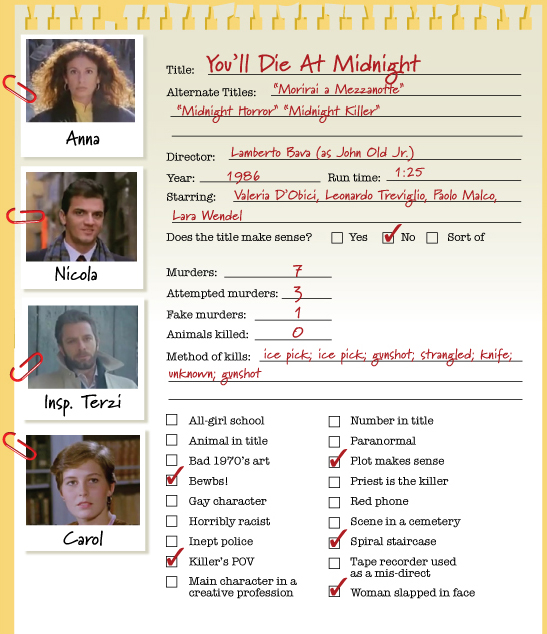
You'll Die At Midnight


You'll Die at Midnight

"Normally the murderer, after the homicidal rage, would surrender."

After police detective Nicola Levi (Leonardo Treviglio) has a vicious fight with his wife, Sara (Barbara Scoppa) he leaves their apartment to cool off, only to discover later that she has been murdered in his absence. It turns out that Sara's murder was committed in the style of notorious serial killer Franco Tribbo, who died in a mysterious fire years ago. Nicola's friend, criminal psychologist Anna Berardi (Valeria D'Obici), is eager to help – partly to aid her friend and partly because she has always been strangely fascinated by the Tribbo case.  Did Franco Tribbo really die all those years ago? Or has his ghost returned to stalk the women of this quiet seaside village? Anna gets help from her graduate students at the local university as well as handsome Inspector Pietro Terzi (Paolo Malco). But as they get closer to the truth, the bodies keep piling up.

You'll Die at Midnight (not to be confused with Death Stalks at Midnight) is the work of director Lamberto Bava , the son of giallo pioneer Mario Bava and protegee of Dario Argento.  The younger Bava is a perennial film student and in this movie he borrows or makes reference to a lot of other, better films. If you look closely, you can find references to Psycho, Four Flies on Gray Velvet, The Girl Who Knew Too Much, The Shining, Halloween, and The Bird with the Crystal Plumage, just to name a few. And these references range from subtle use of props and locations to full-on shot-for-shot re-makes and brazenly copied plot elements. Which isn't to say that You'll Die at Midnight isn't effective. By 1986 the traditional giallo was dying away because audiences preferred the bloodier thrills of slasher flicks. I'd like to think that Lamberto was trying to make a slasher-like giallo full of these references, to remind people about all the classic films that inspired him.
  • One of the many things Lamberto Bava borrows from Argento is Claudio Simonetti, Argento's longtime composer, who is sometimes credited along with his band, Goblin.
  • The village is beautiful and I have to wonder where this movie was filmed. It's a bustling, youthful seaside town with a university and a large natural history museum, but it has the Medieval architecture of a tiny, ancient city. Be careful, though – the fog can roll in quickly and unexpectedly.
  • None of the various titles make any sense. But then again, who would see a movie called You'll Die Around Mid-Afternoon Between Three and Five PM?
  • Actually, the title may be a reference to the 1971 giallo The Man With Icy Eyes, in which  Antonio Sabato and Barbara Bouchet receive threatening notes reading "You'll die at midnight."
What the Hell am I Watching?

During the fight with Sara, Nicola is stabbed in the shoulder with an ice pick, about two inches deep. We're talking serious muscle and nerve damage here and he just walks it off like it's nothing. A little gauze does the trick.

Clearly, Italian hospitals need better security, if anyone can walk in off the street and look up confidential patient files.

You know things are going to get good when Anna's three female grad students move into a large abandoned hotel to finish their thesis papers.

One of my favorite scenes was in the hotel kitchen. The killer attacks Monica (Eliann Miglio) with a knife and she fends him off with a hand mixer... until the cord pops out of the wall. You know that's how the circular saw scene from My Dear Killer should have gone.

 Fashion Moment

SPOILER ALERT!

Lamberto Bava loves to drop visual clues to the identity of the killer throughout the movie and You'll Die at Midnight has a prime example.  Here's Nicola's apartment, the site of the first murder. Note the white decor with neon yellow accents:


Now here's an outfit Anna wears a few days later. Notice how her clothes tie her to the crime scene:


In fact, her outfits become darker and darker thoughout the film, but the yellow accents remain a constant motif:


In this shot, Carol has just had an encounter with the killer and is now wearing yellow to indicate her connection. Remember that the Italian word for "yellow" is... "giallo."

Boom!

Mind. Blown.

Blood and Black Lace


Blood and Black Lace

"Perhaps the sight of beauty makes him lose control of himself and kill."

When fashion model Isabella (Francesca Ungaro) is brutally murdered, her colleagues at the Christian Couture fashion house are distressed. But when her diary surfaces, filled with the details of a complex web of blackmail, everyone wants to get their hands on it to keep their secrets from being exposed – and one person will even kill! As the diary changes hands, the models are murdered one by one by a faceless figure in black. Could one of the implicated models, like Peggy (Mary Arden) or Greta (Lea Lander, credited as Lea Krugher) be responsible? Or was it Max Marian (Cameron Mitchell), the fashion house's business manager?  It's up to Inspector Silvester (Thomas Reiner) to untangle this mystery.

Blood and Black Lace isn't the first giallo film, but I'm starting this blog with it because it is absolutely a must-see for those who are interested in the world of giallo. This movie is by far the most iconic and influential film of the genre, setting up the format of a series of beautiful women getting murdered in stylish ways, as well as introducing the "look" of the classic giallo killer: a faceless man in a black hat, coat, pants, and gloves. I highly recommend viewing the DVD of Blood and Black Lace because it includes the best, most illuminating commentary track I've ever heard, by Bava scholar Tim Lucas of Video Watchdog. Here are a few highlights:
  • Mario Bava defied convention by shooting this movie in vivid, saturated color. Up until then, color was for comedies and musicals, while dramas and thrillers were always done in black and white.
  • Because of this, Bava was able to color-code the film. Each killing and character is assigned its own color, reflected in lighting, set design, and costumes. Isabella is red; Nicole is blue; Peggy is gold; Greta is green; Tao-Li is white; the final murders are black. These color assignments recur throughout the film. For example, it's Isabella's murder that starts the plot, so flashes of red (her diary, fingernail polish, Max's phone) tie objects and characters back to her murder. Some have speculated that this is an homage to Edgar Allan Poe's story "The Masque of the Red Death," set in an allegorical series of colored rooms.
  • As I mentioned, Blood and Black Lace is highly influential in the world of giallo. Dario Argento's color sense can be traced back here, plots, settings, and characters are often borrowed and, throughout the genre, you'll see mannequins and harps used as props as a tip of the hat to this film. Most notably, though, the movie Death Walks at Midnight borrows Blood and Black Lace's signature murder weapon – a unique spiked iron glove.
  • Near the end of the movie, the camera moves through the dark studio into the office, through a doorway draped in red velvet curtains, like a theater proscenium – literally "opening the curtain" on the film's final scene. Dario Argento would borrow this effect in Four Flies on Gray Velvet, Deep Red, and Opera.
  • So you thought Scream was clever, having two killers in cahoots, giving each other an alibi? Guess what? Blood and Black Lace did it first, back in 1964. That's 14 years before the genre that Scream parodies was even invented.
What the Hell am I Watching?

This is a classy production, but it really pushes the envelope when it comes to the murder scenes, by 1964 standards.  For example, poor Peggy is choked, beat up, dragged up a flight of stairs, and burned alive on a hot stove. Then her body is loaded into the trunk of a car, driven to the country, hauled up more stairs, and hidden behind a screen before the police discover it. Mary Arden spent more time playing a corpse in this movie than she did playing a live person.

Nicole's (Ariana Gorini) murder really raises the bar on artistry, though. Bava expertly and stylishly cranks up the suspense as Nicole makes her way through a dark antique shop, lit only by flashing neon lights. It is both beautiful and frightening. And that's what giallo is all about.

Fashion Moment

This is a movie set in the world of fashion, so clothes and accessories figure in pretty strongly to the story. First, have a look at Fashion Director Christina Como (Eva Bartok). She only wears black since the death of her husband, but this evening look is stunning.


Only Nicole is  brave enough to wear the "cursed" black dress that Isabella was supposed to model.


In that same scene, all eyes are on Nicole's purse, which holds Isabella's diary.


And, of course, we must mention the movie's most memorable accessory: the iconic spiked metal glove.